There’s a gap between what official travel and safety resources assume women need to know, and what women actually rely on when they’re making real decisions alone on the road. I’ve spent the last year documenting that gap, both as a solo traveler myself and as a researcher studying how information moves through this community. What I’ve found so far is consistent enough that I think it’s worth laying out plainly.
The Official Sources Aren’t Wrong, They’re Just Incomplete
Government tourism sites, park service pages, and general travel safety guides tend to offer the same baseline advice: lock your doors, tell someone your itinerary, carry a first aid kit. None of that is bad advice. But it’s generic by design, written for a broad audience, and it rarely accounts for the specific calculations a woman traveling alone actually makes. Which site has a clear sightline from the road. Whether a campground host is present after dark. How to read a group of strangers already settled in before you commit to staying the night.
That kind of knowledge doesn’t come from a brochure. It comes from other women who have already made the trip.
Where the Real Information Lives
In my fieldwork and in the private research community I’ve built around this project, the pattern is consistent. Women trust information most when it comes from another woman who has been in a similar situation, not from an institutional source, however well intentioned. Private Facebook groups, small networks built on shared experience, and word of mouth passed between women who workamp or travel the same regions carry more weight than official guidance, even when the official guidance is technically correct.
This isn’t a preference for gossip over expertise. It’s a rational response to a real problem. Institutional sources are often written by people who have not done the thing they’re advising on. A woman who has actually pulled into an unfamiliar campground alone at dusk knows things a safety pamphlet writer does not. That lived experience becomes the currency these networks run on.
Naming the Data Gap
Here is the part that matters most for where this research is headed. There is very little formal, published data on how solo women travelers over 40 evaluate safety information, decide what to trust, and build the informal networks that fill the gaps left by official sources. Most existing research on the digital divide and information access focuses on general populations or on younger users. Almost none of it looks specifically at how mobility, gender, and age intersect for women navigating independent travel and public lands access later in life.
That absence is not a small oversight. It means the systems currently being built, apps, safety tools, informational platforms, are often designed without input from the population most affected by the gap. If nobody has asked the question with any rigor, the tools built to answer it are guessing.
Why This Is the Center of My Research
This is the problem Solo Sojourn exists to study. Not simply to document that the gap exists, which the fieldwork and community conversations already make clear, but to understand its shape with enough precision that it can inform how platforms, public land partners, and safety resources actually get built going forward. That means treating the private Facebook group conversation and the woman explaining her check in routine at a campfire as legitimate data, not anecdote, and studying it with the same rigor as any other information behavior research.
It also means being honest about scope. This is not a claim that informal networks are always sufficient or that institutional resources should be ignored. It is a claim that the current picture is incomplete, and that solo women travelers are already doing sophisticated information work to fill that gap on their own, often without recognition or support.
Where This Is Headed
The screening survey currently open through this project is the first formal step in gathering that data systematically, moving from fieldwork observation toward a structured research record. If you are a solo woman traveler, or you have experience with independent travel, workamping, or public lands access, your perspective is exactly what this research needs. The survey takes about five minutes, and it directly shapes the next phase of this work.
You can find it at solosojourn.org/beta-testing/.
Author’s Note
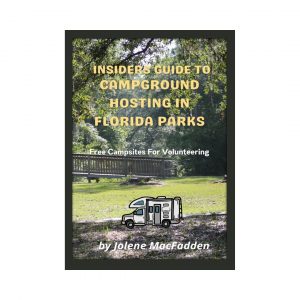
You can always purchase a copy of the book I wrote about Park Hosting (Workamping) in Florida Public Land areas from me directly and I will be happy to autograph it. This book was the basis of my app’s database and I hope to write a more updated one in the future.